Physical Therapist Reviews Every Plantar Fasciitis Option — From $20 Amazon Splints to $800 Custom Orthotics — and Reveals What She'd Actually Tell Her Own Mother

My name is Dr. Sarah Mitchell. I spent 22 years as a physical therapist specializing in foot and ankle rehabilitation.
And I need to tell you about the biggest mistake I made for the last three of them.
I stopped recommending night splints.
Not because they don't work — I'll show you the guideline that says they should in a moment. I stopped because I got tired of watching the same scene play out every Monday morning in my clinic.
A woman in her late fifties sits down across from me. She looks tired. Not from the pain — from the disappointment. She tried the boot I recommended. She really tried. She made it to 2 AM the first night, midnight the second night, and by the third night it was on the floor of her closet next to the $25 Amazon brace she'd already given up on.
She says it like she's apologizing. Like it's her fault. Like she wasn't disciplined enough.
It wasn't her fault. It was never her fault.
I heard it from nurses who spend ten hours on their feet and just want one decent night of sleep. From retirees whose mornings have become a five-minute process of hobbling to the bathroom, gripping the dresser, walking on the edges of their feet. From a woman who told me she'd stopped visiting her grandchildren because she couldn't keep up with them anymore — and then went quiet, because saying it out loud made it real.
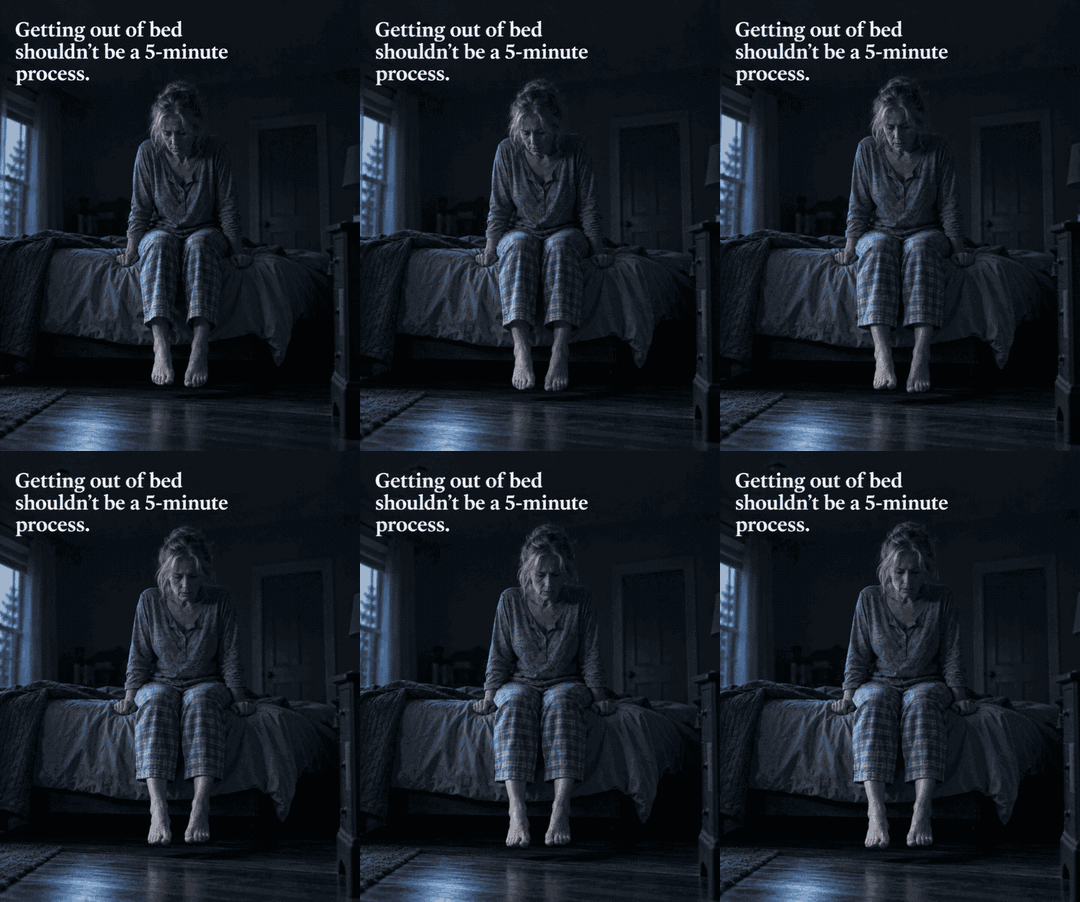
These aren't people looking for a miracle. They just want to get out of bed and walk to the kitchen like a normal person.
After hearing this hundreds of times, I quietly gave up on the one intervention that the clinical guidelines say should be helping them most. I told them to stretch. Ice. Better shoes.
I knew I was handing them the second-best answer.
That decision bothered me for three years. And what I've found since then is the reason I'm writing this today.
First — You Need to Understand What's Happening at 6 AM
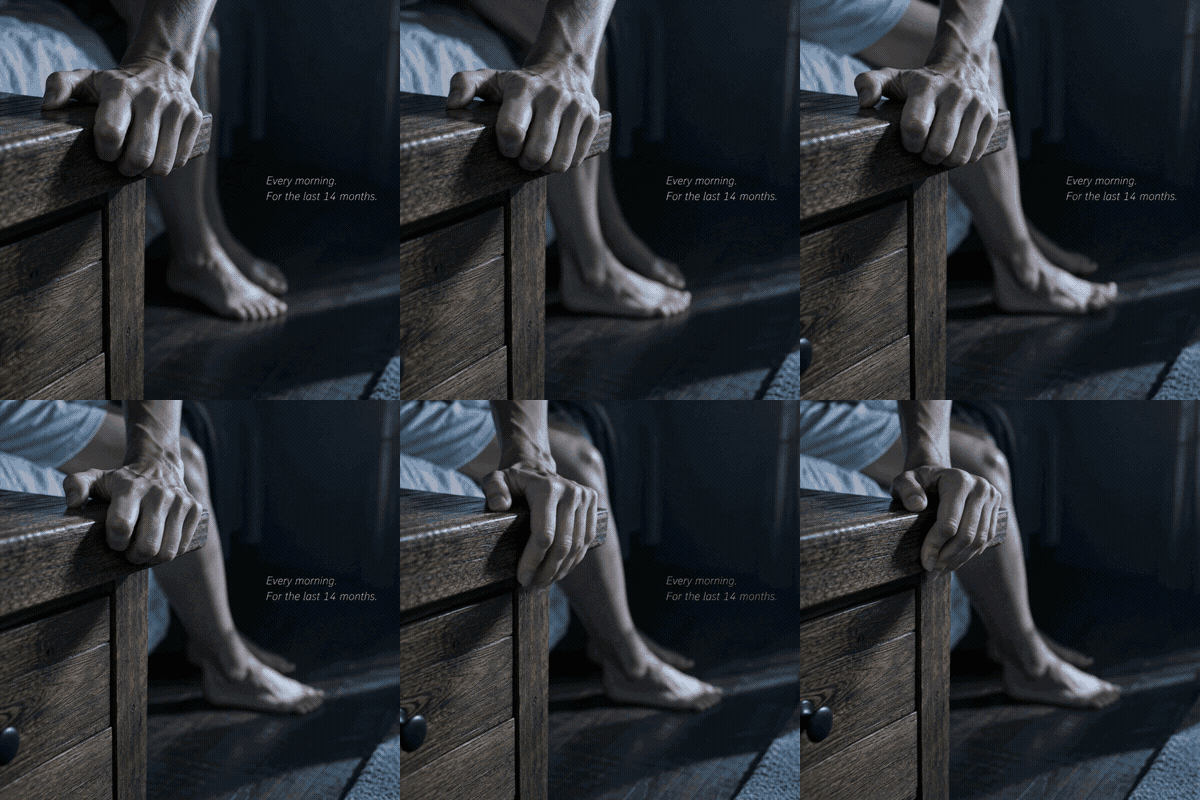
You already know what your mornings feel like. I don't need to describe the pain to you — you live it.
But there's a reason it happens, and it's not random. Once you see it, everything else in this article — what works, what doesn't, and why you haven't found the right answer yet — will click.
Think of a rubber band left bunched up in a drawer overnight. Pull it out in the morning and try to stretch it fast. It resists. It's stiff. If you pull hard enough, it could snap.
That's what's happening inside your foot.
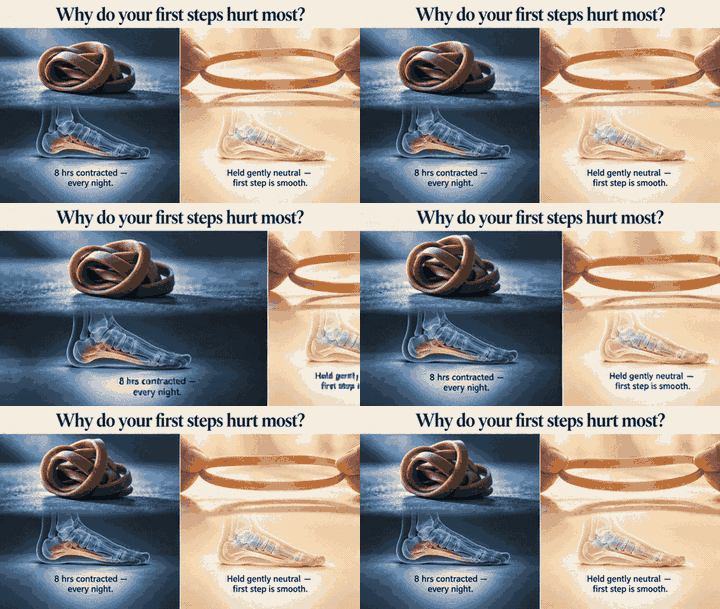
When you sleep, your foot naturally relaxes into a pointed-down position — toes drifting toward the end of the bed. Completely normal. Your body does this every night. But over 7 or 8 hours in that position, the thick band of tissue along the bottom of your foot — your plantar fascia — slowly tightens and shortens. It sets like that rubber band.
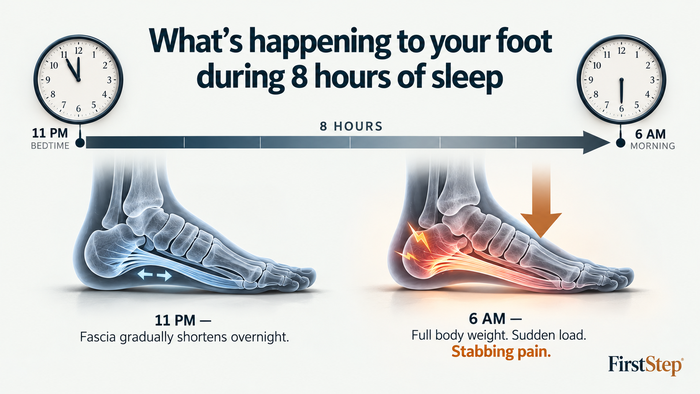
Then your alarm goes off. You swing your legs over the side. You put your weight down. And your full body weight forces that cold, stiff tissue to suddenly stretch.
That's the stabbing. That's why you dread the moment your feet touch the floor. That's why some mornings you just sit on the edge of the bed for a minute, working up the nerve.
It's not weakness. It's mechanics.
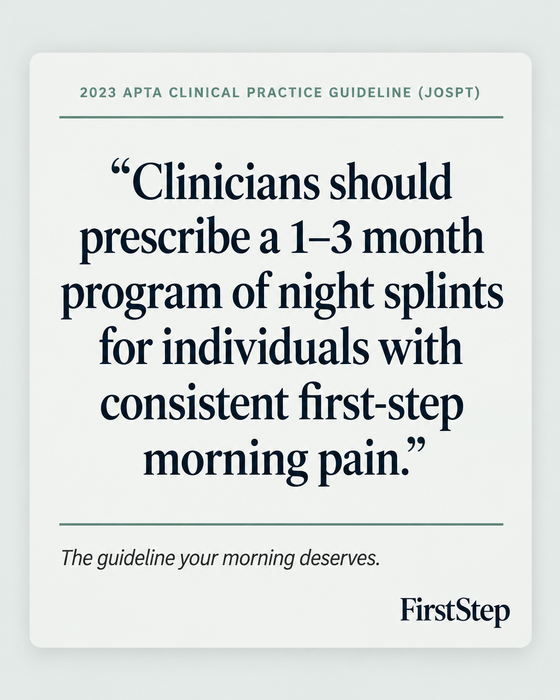
And the fix, on paper, is straightforward. The 2023 APTA Clinical Practice Guideline — the most authoritative document in my profession on this topic — says clinicians should prescribe a 1-to-3-month program of night splints for people who consistently have pain with the first step in the morning. Hold the foot gently near neutral while you sleep so the tissue can't shorten overnight, and that brutal first step doesn't have to be brutal.
Simple concept. Clear guideline.
One enormous problem: almost every device designed to deliver on that promise makes it impossible to actually sleep.
And a device that needs 8 hours to do its job is useless if it wakes you up after 2.
I spent the past two years looking at every option available — from $20 Amazon socks to $800 custom orthotics — to understand why so many people try to fix their mornings and end up right back where they started. Tired. Frustrated. Convinced they've tried everything.
Here's what I found.
1. Custom Orthotics ($300–$800)
Most podiatrists start here. Custom-molded insoles, shaped to your foot, designed to support your arch during the day.
I won't pretend they're useless. For some people, they genuinely help with daytime discomfort.
But custom orthotics can't do anything about your mornings. You're not wearing them in bed. By the time you lace up your shoes and put them to work, the worst part of your day already happened — barefoot, on the cold floor, thirty minutes ago.
They treat the daytime load. Your mornings are an overnight problem.
And they cost $300 to $800.
I've lost count of how many patients have told me some version of this story: "I paid $450 for custom orthotics and I don't even wear them." Some found them uncomfortable — one woman described hers as "essentially wearing a rock in my shoe." Others wore them faithfully for months, felt modest improvement during the day, and still woke up every single morning with the same stabbing heel pain that made them dread their alarm.
Because the orthotics weren't in bed with them. They couldn't be.
If your worst moment is that first step after 8 hours of sleep — not the walk to your car, not the grocery store trip, but those first brutal moments before you're even fully awake — custom orthotics are an expensive answer to a question your mornings never asked.
And the morning stays the same.
2. Cortisone Injections
I'll give cortisone this: it works fast.
A steroid injection directly into the heel attachment can drop the pain significantly within days. I've seen patients almost cry with relief at their follow-up. After months of hobbling, they walk in and just — walk. Normally. For the first time in a long time, getting out of bed doesn't require a plan.
That part is real. I'm not going to minimize it.
But it wears off.
Every clinical review I've read describes the benefit as short-term. Two to four months is typical. One patient told me hers "worked for about four months" and then the pain returned exactly as it was — same intensity, same morning pattern, same dread.
She was right. The hope-and-crash cycle is its own kind of suffering. And repeated injections carry a real medical risk — weakening of the fascia and, in rare cases, rupture. The literature is clear on this.
More importantly, cortisone doesn't change what happens overnight. The injection addresses the pain at the site, but your foot still drops into that contracted position for 8 hours every night. The same tightening. The same shortening. The mechanism keeps running even while the pain signal is temporarily muted.
When the injection wears off, the cycle picks up right where it left off. Except now you've been through a needle, you've waited four months, and the morning is just as bad as it was before.
Relief without resolution.
And the morning stays the same.
3. Stretching and Physical Therapy
This one matters to me, because I spent my career prescribing it.
Stretching genuinely helps. The clinical guidelines list it as a first-line treatment, and I recommended calf stretches and plantar fascia stretches to nearly every patient who walked into my office. Done consistently, they make a real difference.
But here's what I learned after 22 years of prescribing them for morning pain specifically.
The worst pain happens before you're awake enough to do anything about it.
I used to tell patients: "Before you get out of bed, do 20 ankle pumps, then loop a towel around your foot and stretch your calf for 30 seconds each side." Textbook advice. Clinically sound.
You know what actually happens at 6 AM?
The alarm goes off. You have to pee. Immediately. There is no "let me complete my bedside stretching protocol" when you're half-asleep and your bladder is screaming. One of my patients said it plainly — and I've never forgotten it:
She wasn't being difficult. She was being honest. And she spoke for about 90% of the patients I ever treated.
But here's the part that quietly broke my heart. The patients who couldn't do the morning stretches didn't just skip them. They felt guilty about it. They thought the reason their feet still hurt was because they weren't disciplined enough. They internalized the failure. "I know I'm supposed to stretch, I just... don't do it."
It wasn't a willpower problem. It was a design problem. We were asking people to perform a multi-step rehabilitation routine in the one moment of the day when they're least capable of performing anything.

What if the stretch already happened? Passively, automatically, over 8 hours of sleep — while you did nothing at all?
That's the entire promise of a night splint. The tissue stays gently elongated all night. No routine. No discipline. No 6 AM ankle pumps while your bladder screams. You just wake up, and the worst of it is already handled.
Which brings us to the devices that are supposed to deliver that promise.
4. Amazon Night Splints and Socks ($17–$30)
This is where I get frustrated. Because this category is actively poisoning the well for people who genuinely need help.
If you've ever searched Amazon for "plantar fasciitis night splint," you've seen the wall. Over 1,000 results. Most of them between $17 and $30. Hundreds of nearly identical listings with stock photos of smiling models and promises about "morning relief."
They fall into two categories, and both fail.
The socks and straps use elastic tension to hold the foot in position. A fabric sleeve with a strap from the toes to the shin. The idea is sound — keep the ankle from dropping overnight.
In practice, they slip. Constantly. The elastic loosens within an hour. The sock migrates up the calf. The strap shifts. By morning, the device has moved to a useless position and your foot spent most of the night in exactly the same contracted state it would have without the sock.
Hundreds of 1-star reviews say the same thing: "Slips down my leg." "Creeps up and angle of stretch is reduced." "Couldn't keep it in place."
The cheap rigid braces are miniature plastic boots sold at a price point that cuts every corner. The Velcro wears out in weeks. I've read reviews from people on their "3rd time ordering" the same $25 splint because the hook-and-loop fails so fast. That's $75 on three disposable devices, none of which lasted long enough to complete even a two-week protocol.
The padding is minimal. The plastic edges dig into the top of the foot. The toe area compresses circulation. "Toes will fall asleep." "Smushes my toes." And the exposed straps catch on bedsheets — "gets caught in my blanket… which wakes me up."
But here's the real damage these products do.
When someone spends $25 on an Amazon night splint, sleeps terribly for three nights, and shoves the thing in a drawer — they don't think "that was a cheaply made product that couldn't maintain its position."
They think: "I tried a night splint. It didn't work."
And they cross the entire concept off their list. Permanently.

The next time a podiatrist or a friend or an article suggests a night splint, they already have their answer: "Tried it. Doesn't work."
Except they didn't try overnight positioning. They tried a $25 device that was engineered to hit a price point, not to survive a real night of sleep.
I can't tell you how many patients I saw who arrived at my clinic already convinced night splints were a gimmick — because of a single bad experience with a product that was never going to work in the first place.
And the morning stayed the same.
5. The Posterior Night Boot: Right Concept, Wrong Design
Now we're at the heart of it.
This is the section I wish I could hand to every patient I ever treated — the ones who tried and failed, and the ones who never tried at all because someone else's failure scared them off.
The traditional posterior night boot is the device most physical therapists and podiatrists picture when they hear "night splint." It's been around for decades. It's the design used in most of the clinical studies that the guidelines are based on. And mechanically, it does exactly what it's supposed to do.
It holds the foot at a neutral angle. Rigid plastic along the back of the calf and under the sole. It keeps the tissue elongated. On paper, it checks every box.
I prescribed it for almost twenty years.
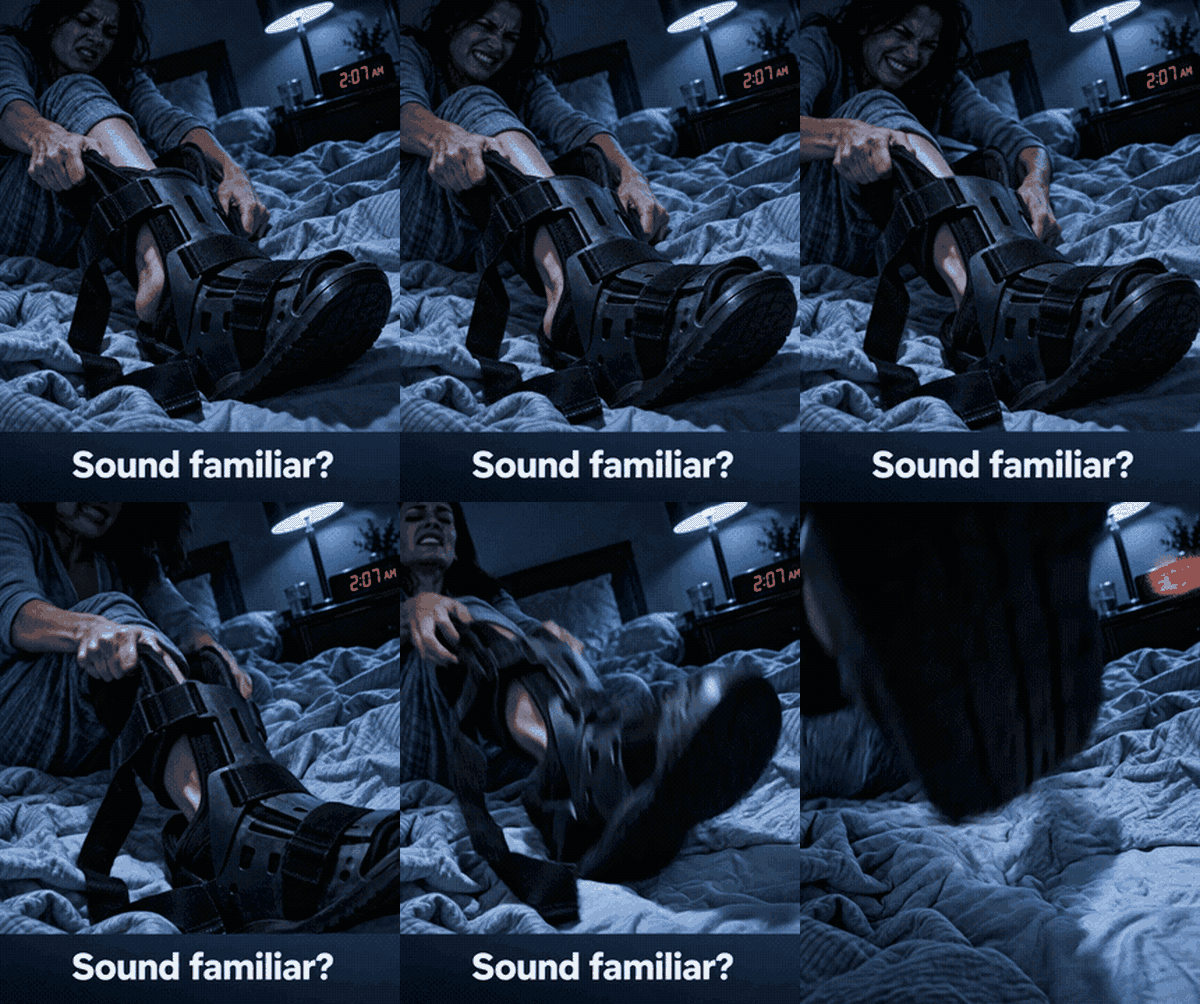
And I watched patient after patient fail with it. Not because they lacked commitment. Not because overnight positioning doesn't work. But because this device — the one the evidence is built on — is fundamentally incompatible with the thing it needs most: 8 hours of actual sleep.
The boot weighs over a pound. It encases the entire foot and lower leg in rigid plastic. Every time you roll over — and the average person shifts position 10 to 15 times a night — a pound and a half of hard shell moves with you. It catches the sheets. It pulls the blankets. It knocks against your other leg. It turns every natural sleep movement into a conscious event.
The foot is fully enclosed. No airflow to the sole, the heel, the toes. Within 30 minutes, it's sweating. For anyone who runs warm at night, this alone makes the boot unbearable past midnight.
And the toes. Most boots have a closed toe box — rigid plastic pressing down from above. After 2 to 3 hours, the toes go numb. Not uncomfortable. Numb. The tingling wakes you up, and when you reach down and feel a hot, sweating, heavy plastic boot crushing your toes in the dark — you don't calmly adjust the strap tension.
You rip it off and throw it on the floor. Every single patient described it the same way. Not "I removed it." Not "I took it off." "I ripped it off."
For couples, there's another layer. The straps catch on the sheets. The boot pulls the covers off your partner. The Velcro scratches their leg. I had patients whose spouses gave them an ultimatum — the boot or a decent night of sleep. The boot lost. Every time.
Here's what the clinical guidelines actually ask for: consistent use, most nights, for 1 to 3 months.
That's not "wear it for 2 hours and then rip it off in a sweat." That's full nights, week after week, for months.
The posterior boot cannot deliver this. Not because patients lack willpower. Because the design requires you to sacrifice 8 hours of sleep in order to get 8 hours of positioning.
That's not a tradeoff. That's a contradiction.
And here's the part that has haunted me for years.
When the boot fails — when they rip it off at 2 AM and it sits in a closet for six months until they throw it away — they don't blame the design.
They blame themselves. "I wasn't tough enough." "I couldn't commit."
Or worse — they blame the concept. They decide that overnight positioning is nonsense. That night splints are a gimmick. That the guideline doesn't apply to them.
And they give up.
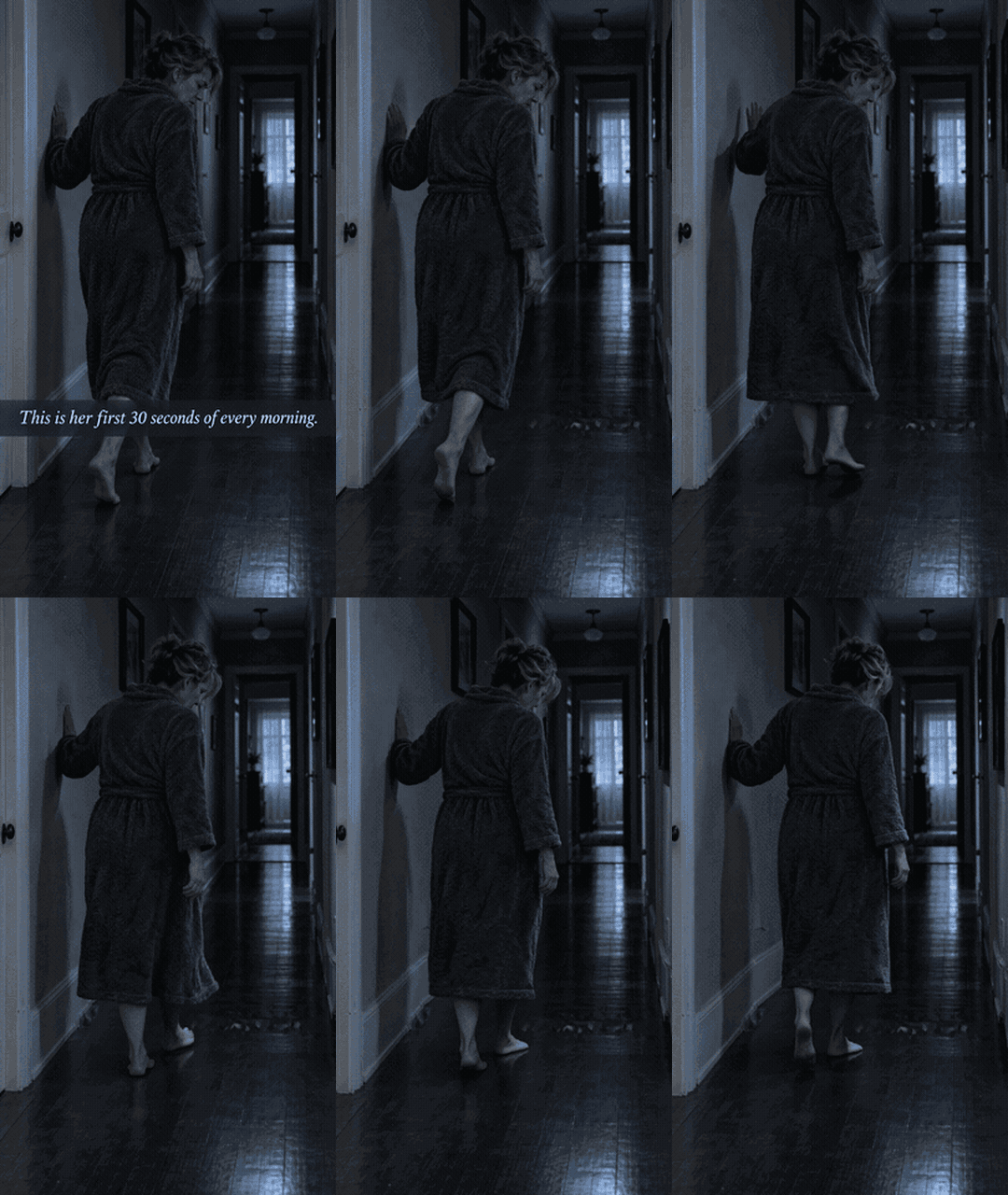
They go back to dreading the alarm. To sitting on the edge of the bed working up the nerve. To hobbling into the bathroom gripping the wall, walking on the outsides of their feet, wondering if this is just what mornings are now.
One of my patients — a woman in her early sixties, retired teacher, used to walk three miles every morning before school — told me she'd "largely lost hope" that her mornings would ever feel normal again. She'd tried the orthotics. She'd tried the boot. She'd tried two Amazon braces. She'd tried stretching. She'd tried icing.
She wasn't lazy. She wasn't uninformed. She'd done everything right.
Every product she tried had failed her. And with each failure, she didn't just lose money — she lost a small piece of the belief that things could get better.
That's what the posterior boot does at scale. It doesn't just fail as a product. It poisons the concept of overnight positioning for everyone who tries it. It takes the single best clinical answer for first-step morning pain and makes people associate it with sleepless nights, numb toes, and disappointment.
Right concept. Wrong design.
For three years, that's where the story ended for me. The guideline was clear. The mechanism made sense. And every device designed to deliver it was engineered for a clinic shelf, not a real bedroom.
I had started to accept that this was just one of those problems the industry couldn't solve — that the gap between what the evidence promised and what the products could deliver was permanent.
Then I came across something that made me reconsider everything I'd given up on.
6. What If the Problem Was Never the Concept?
For three years, I accepted it. The guideline was right. The mechanism was sound. And the devices were unbearable.
I had started telling patients to just stretch more. Sleep in supportive socks. Try ice before bed. I knew it was the second-best answer. But it was an answer people could actually live with, and after watching enough patients break down in my office about another product that failed them, "good enough" felt more honest than "perfect on paper."
Then a colleague — a sports PT in Portland — mentioned something that stopped me mid-sentence during a conference call.
I had not. Or rather — I had seen them years ago in a supply catalog and dismissed them. They looked flimsy. Insubstantial. Like someone had taken a night splint and removed all the parts that make it a night splint.
She told me to look again. Specifically, she told me to look at where the support structure sits.
That single detail changed everything I thought I knew about why patients fail with night splints.
Here's what I'd missed.
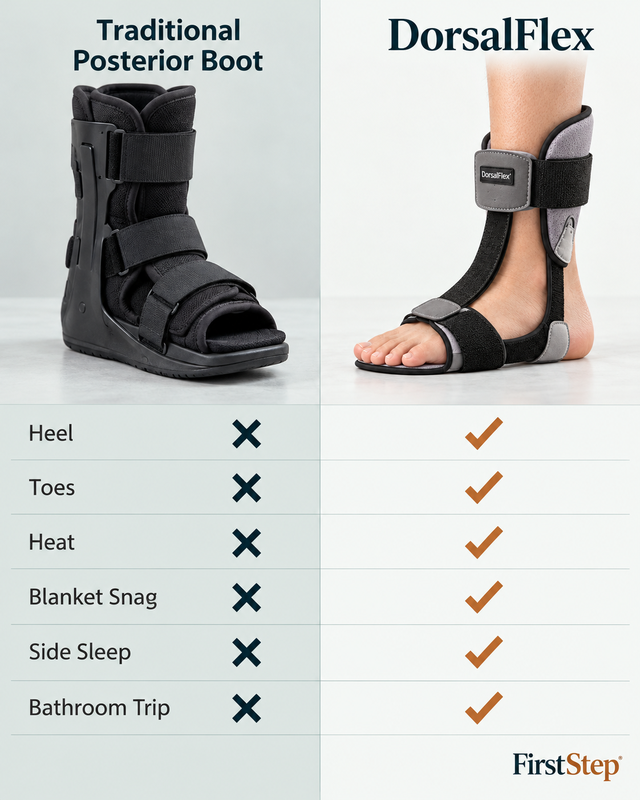
Every posterior boot I'd ever prescribed puts the rigid structure behind the leg. A plastic shell runs down the back of the calf, under the heel, and along the sole to the toes. It holds the foot at the right angle — but it does it by encasing the entire foot in a rigid coffin of plastic.
That's why it traps heat. That's why the toes go numb. That's why it catches on blankets. That's why a pound and a half of hard shell moves with you every time you roll over. The positioning is correct. The architecture is hostile.
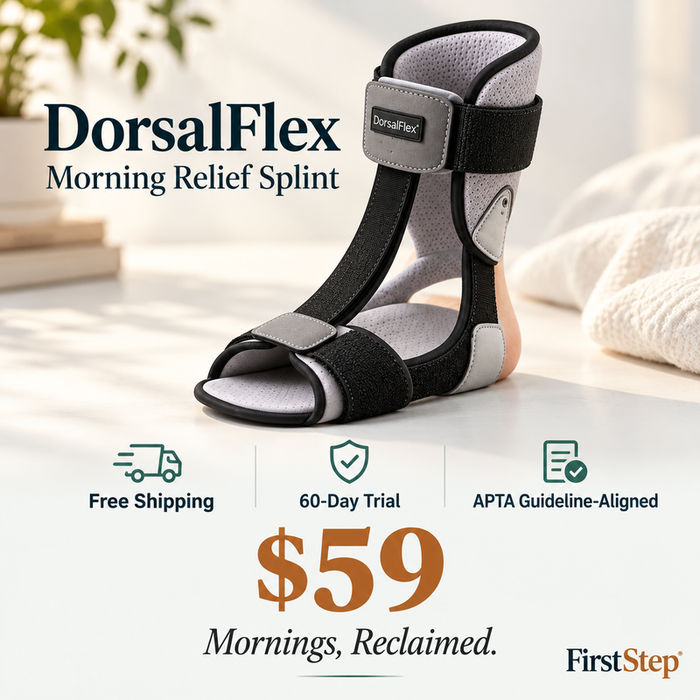
A dorsal design flips the entire concept.
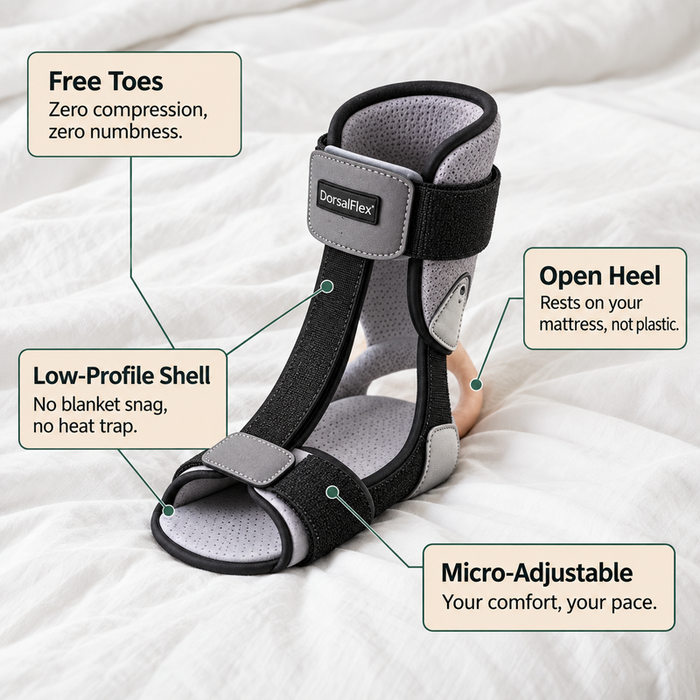
The support structure sits on the front of the shin — a lightweight, padded shell along the top of the foot and up the front of the lower leg. It holds the ankle at the same gentle neutral angle. Same positioning. Same principle. Same guideline being fulfilled.
But the heel is open. The sole is open. The toes are completely free.
Nothing is encasing your foot. Nothing is trapping heat against your skin. Nothing is pressing down on your toes for 8 hours until they tingle and go numb in the dark. Nothing rigid is catching on your sheets every time you shift position.
Your foot is being held in the right position — gently, from the top — while everything that made the old design unbearable simply isn't there anymore.
I remember the moment this landed for me. I was sitting at my desk, looking at a cross-section diagram of both designs side by side, and I actually said out loud: "Why wasn't it always done this way?"
Because it should have been.
The entire reason night splints have a reputation as torture devices — the entire reason patients rip them off at 2 AM, the entire reason I stopped recommending them, the entire reason people who genuinely need overnight positioning have crossed it off their list — comes down to one design decision: putting the rigid structure behind the leg instead of in front of it.
Right concept. Wrong architecture. For decades.
7. The DorsalFlex
When I found the DorsalFlex, I didn't recommend it to a patient right away. I tried it myself.
Not because I have plantar fasciitis — because I needed to know what 8 hours in this thing actually felt like before I'd put my name next to it. I'd spent three years watching patients cry in my office about devices I'd recommended. I wasn't going to do that again.
So I wore it. A full night. Then a second. Then a full week.
Here's what I noticed:
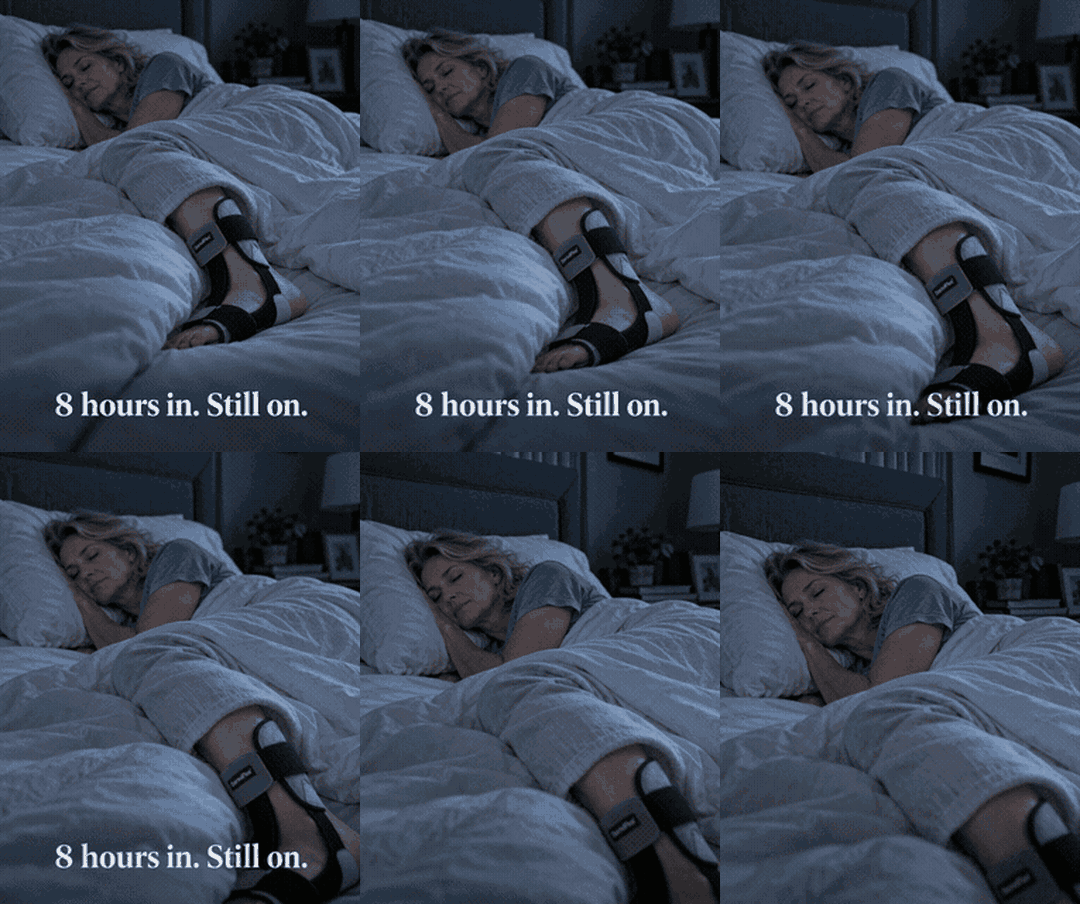
Not metaphorically. I literally forgot. I woke up at 6:15 the first morning and looked down at my foot because something felt different — and it took me a full second to register that the splint was still on. It hadn't woken me up. It hadn't shifted. My toes weren't tingling. My foot wasn't sweating. My sheets weren't bunched up.
I just… slept. With a night splint on. For the entire night.
That had never happened with a posterior boot. Not once. Not in 22 years.
Let me walk you through what makes this different — not in clinical terms, but in terms of what you'll actually feel in bed.
The First Week: An Honest Conversation
I need to tell you something that most companies selling night splints won't.
The first night might feel a little unusual.
Not painful. Not uncomfortable the way a posterior boot is uncomfortable. Just… different. You're not used to having anything on your foot while you sleep. Your brain notices it. That's normal.
The DorsalFlex comes with a 2-week acclimation protocol. It's simple:
Night one, wear it for two hours before bed while you read or watch TV. Night two, try a little longer. By the end of the first week, most people are wearing it through the entire night without thinking about it.
You don't have to be tough. You don't have to white-knuckle through a miserable night and hope you wake up with willpower intact. You just have to be a little patient for about seven days.
One of the people who tried this splint described the adjustment like this:
A disaster on night one. Relief by week two. That's not failure — that's an adjustment curve. And the acclimation protocol is designed to make that curve as smooth as possible.
8. What Mornings Feel Like After Week Three

This is the part I've been waiting to tell you.
I've now shared this splint with dozens of people — patients, former patients, friends, colleagues' parents. And the part that keeps hitting me isn't the clinical outcome. It's the look on their faces when they describe their mornings.
There's a woman I worked with — a retired teacher, 62, three-mile morning walks before school every day until plantar fasciitis took that away from her. She'd tried the orthotics. She'd tried the boot. She'd tried two Amazon braces. She'd told me she had "largely lost hope" that her mornings would ever feel normal again.
Six weeks after starting the DorsalFlex, she sent me a message. Two sentences:
She didn't say the pain was gone. She didn't say she was cured. She said she made coffee before she thought about her feet.
That's what normal feels like. You don't notice it. You don't brace for it. You don't plan for it. Your feet just… work. And you go about your morning like a person whose body isn't punishing them for sleeping.
Another woman — a nurse, 48, ten-hour shifts on her feet — told me she'd stopped dreading her alarm. Not because of the work. Because of the first thirty seconds after it went off. Those thirty seconds of sitting on the edge of the bed, working up the nerve, knowing what was coming the moment she stood up. "Getting out of bed shouldn't be a five-minute process," she'd told me once, months earlier.
After three weeks with the DorsalFlex, she said:
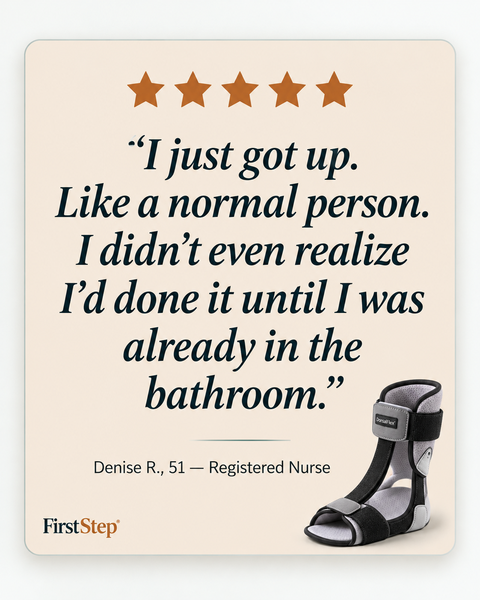
That's the shift. Not a dramatic before-and-after. Not a miracle. Just the absence of dread. Just mornings that start with coffee instead of pain. Just standing up without gripping the nightstand.
"It does help to reduce the excruciating pain I experience when I first get out of bed," one person told me simply, "and that's more than enough for me."
More than enough. After months or years of dreading the alarm, "more than enough" is what freedom sounds like.
Ready to try a morning without the hobble?
60-day risk-free trial. Free shipping. Works while you sleep.
Try the DorsalFlex Risk-Free →9. What I'd Tell My Own Mother
My mom is 71. She doesn't have plantar fasciitis — but she has friends who do. One of them, a woman she walks with every Tuesday and Thursday, has been hobbling for the better part of a year. She's tried the insoles. She's tried the stretches. She told my mom she's "just getting old."
She's not getting old. She's dealing with a tissue problem that has a known, guideline-supported intervention — one that's been sabotaged for decades by devices that make it impossible to sleep.
If my mother's friend called me tomorrow and asked what to do, I wouldn't tell her to spend $400 on custom orthotics she'll stop wearing. I wouldn't tell her to try a cortisone injection that wears off in four months. I wouldn't tell her to buy a $25 Amazon splint that'll slip down her leg the first night and end up in a drawer.
I'd tell her to try the DorsalFlex. Wear it for the full 60-day trial. Follow the acclimation protocol. Give it an honest three weeks.
And I'd tell her the same thing I'm telling you now: if it doesn't work, send it back. No guilt. No cost. No risk.
But I'd also tell her this — the part that matters to me more than the clinical mechanism or the design architecture or any of the things I've spent this article explaining:
You haven't failed. Every device that ended up in your closet, every night splint you ripped off at 2 AM, every pair of $300 insoles collecting dust — that wasn't you failing. That was a poorly designed product failing you. The concept of overnight positioning works. The 2023 guideline is clear on that. What didn't work was the delivery system.
This is a different delivery system. And for the first time in my career, it's one I can recommend without apologizing in advance for what it's going to do to your sleep.
10. The Real Cost of Doing Nothing
I know what you're thinking. $59. For a night splint.
You've seen them on Amazon for $17. You've seen the socks for $22. You've seen rigid braces for $25. And you're wondering why this one costs more than double.
Let me reframe that question.
How much have you already spent?
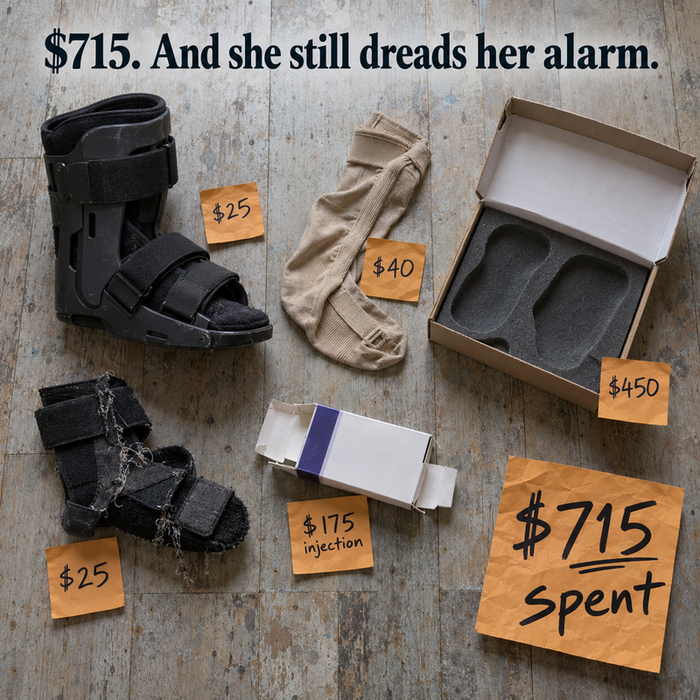
One woman I treated had bought three different night splints over 18 months. Two Amazon braces at $25 each. One Strassburg sock at $40. That's $90 — on three devices that all ended up in the same drawer, none of which lasted longer than a week on her foot.
Another spent $450 on custom orthotics. "I don't even wear them," she told me. That's $450 for an insole that — even when worn — can't do anything about the 8 hours your foot spends contracted in bed.
Cortisone injections typically cost $150 to $200 per shot. Four months of relief. Then the morning comes back, exactly as it was. Two shots a year is $300 to $400 — for a temporary mute button on a problem that's still running underneath.
The DorsalFlex is $59.
It comes with the splint itself, a bedside First-Steps Routine Guide, and the 2-week acclimation protocol. Free shipping.
$59 is less than a single podiatry copay. Less than a set of orthotics you may not wear. Less than two cortisone injections that wear off. And far less than buying the same $25 Amazon splint three times because the Velcro stops holding after three weeks.
But here's the thing I want to be clear about: $59 is not the point.
The point is that this is the first night splint I've ever recommended that people actually keep on their foot all night. And a device that works for 8 hours is infinitely more valuable than a device that works for 2 hours before you rip it off — no matter what either one costs.
11. The Guarantee: 60 Days, No Questions
Here's what I want you to do.
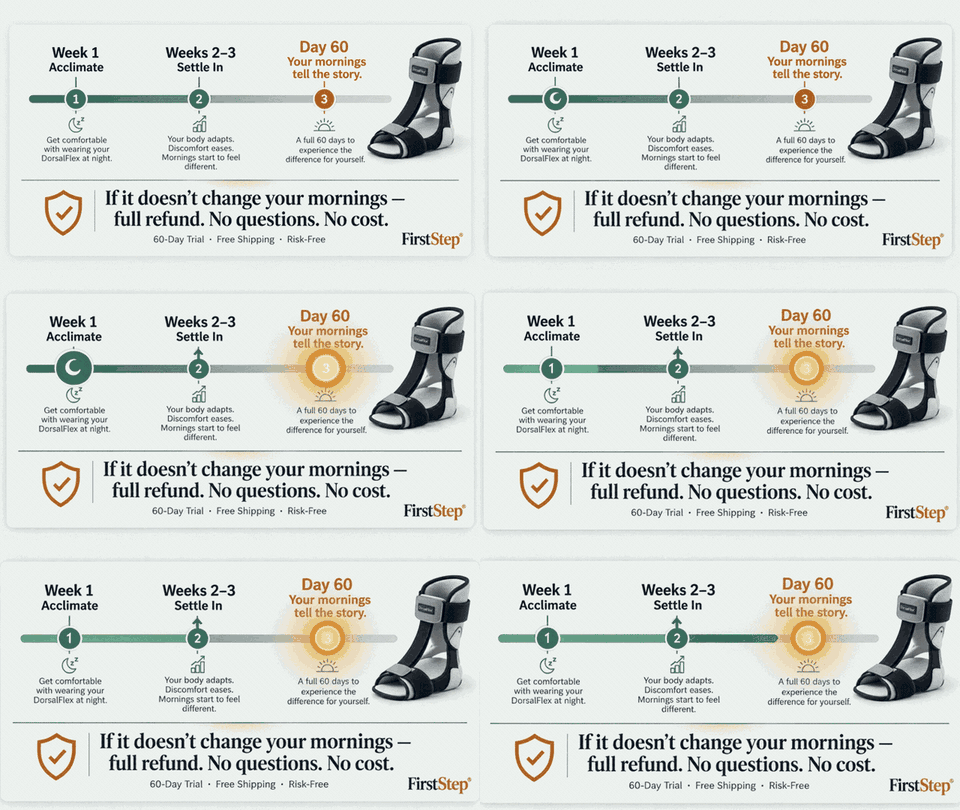
Try the DorsalFlex for 60 days. Follow the acclimation protocol. Give your body one honest week to adjust to the feel of wearing something on your foot at night. Then wear it every night for the next few weeks and see what your mornings become.
If after 60 days you're still waking up with the same dread, the same stabbing, the same hobble to the bathroom — send it back. Full refund. You won't owe a dime. You won't even owe an explanation.
I'm not asking you to take a leap of faith. I'm asking you to take a 60-day test drive with a full safety net underneath it.
Because after everything you've been through — the boots, the braces, the insoles, the injections, the stretches you couldn't do at 6 AM because you had to pee — you deserve to find out whether this works without risking anything except eight weeks of slightly better sleep.
My Recommendation
I spent 22 years as a physical therapist. I prescribed every device in this article. I watched them help some people and fail many more.
The DorsalFlex is the first night splint I've ever been able to recommend without a disclaimer. Without the apology. Without the "I know it's uncomfortable, but try to stick with it."
It's the splint I'd give my own mother. It's the splint I wish I'd had for the hundreds of patients who gave up on overnight positioning because the only device available was a sweat-box boot that turned every night into a battle.
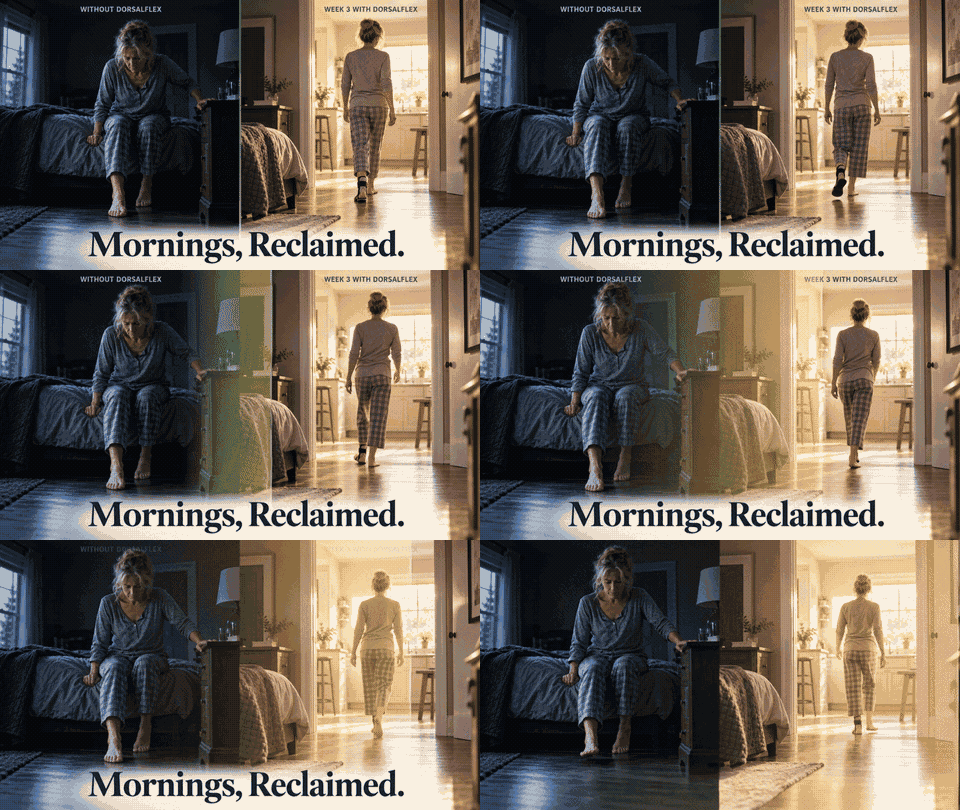
If your worst moment is that first step in the morning — if you've been sitting on the edge of the bed, gripping the nightstand, walking on the outsides of your feet, wondering if this is just how mornings work now — this is the thing I'd want you to try.
Not forever. Not on blind faith. Just for 60 days, with a full refund if it doesn't change your mornings.
Because you haven't run out of options. You just haven't tried the right one yet.
The 2023 APTA Clinical Practice Guideline recommends 1 to 3 months of consistent night splinting for people who consistently have pain with the first step in the morning.
The Comfort Set. Includes the DorsalFlex plus a second set of premium cushion pads — swap them weekly for a fresh feel and longer pad life. $79
Get the Comfort Set →Both feet hurt? About one-third of plantar fasciitis cases affect both feet. The DorsalFlex 2-Pack is available for $109 — $9 less than buying two separately. That's two splints for just $30 more than a single + spare pads.
Get the 2-Pack →
Reader Comments
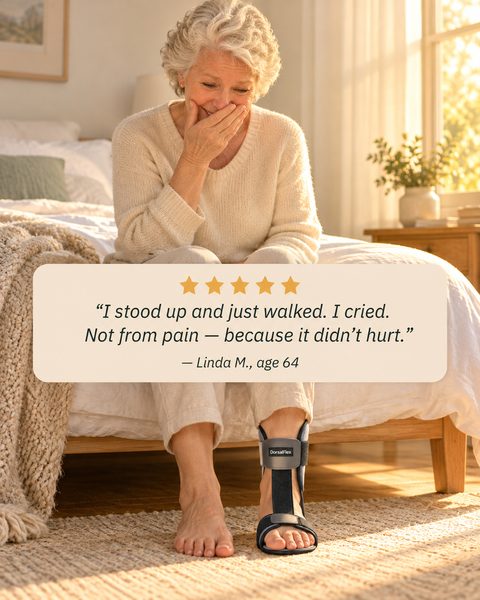
I'm going to be honest — I almost didn't order this. I've bought two night splints from Amazon in the last year and both ended up in my closet within a week. The first one slipped down my leg every single night. The second one made my toes go completely numb by 1 AM. I was done with night splints. My daughter sent me this article and I figured, fine, one more try with the 60-day return policy. I'm so glad she pushed me. The first three nights were weird — not painful, just different. By night five I barely noticed it. By week three, I walked to the bathroom at 5:30 AM without thinking about it. Without gripping the wall. Without walking on the edges of my feet. I stood up and just… walked. I cried in the bathroom. Not from pain. From the fact that it didn't hurt. I'm 64 years old and I'd convinced myself this was just how mornings work now. It's not.
Nurse here, 51, on my feet for 10-hour shifts. Mornings were the worst part of my day — not the shifts, just getting out of bed. I'd set my alarm 10 minutes early just to sit on the edge of the bed and do ankle pumps before I could walk. My podiatrist recommended a night boot two years ago and I lasted exactly four nights. It was like sleeping with a brick strapped to my leg. My husband said it was pulling all the covers off him. Ordered the DorsalFlex because of the 60-day trial. Followed the acclimation protocol exactly. One hour the first night. Two hours the second. By the end of the week I was wearing it all night. Three weeks in, I got out of bed and was halfway down the hallway before I realized I hadn't done my ankle pumps. Didn't need to. Just got up and walked. I actually teared up telling my husband about it at dinner that night.
I ordered this for my wife. She's been dealing with plantar fasciitis for over a year and the mornings were hard to watch. She'd swing her legs over and just sit there, sort of mentally preparing. Then she'd stand up and do this slow, careful shuffle to the bathroom with her hand on the wall the whole way. She tried custom orthotics ($375, barely wears them) and a cortisone shot that helped for maybe three months. She was skeptical about this but agreed to try it because of the money-back guarantee. She's on week four now. The first week was rocky — she took it off a couple times — but she stuck with the acclimation guide. Last Saturday morning she got up and walked to the kitchen before I did. Didn't mention it. Didn't make a thing of it. Just got up. That's when I knew it was working.
Four stars only because the first night was rough and I almost returned it — I want to be honest about that. But I followed the acclimation protocol and by night four it felt completely normal. I've been wearing it nightly for five weeks now. My mornings aren't perfect — I still feel some tightness for the first few steps — but the STABBING is gone. That sharp, take-your-breath-away pain that used to hit the second my heel touched the floor? Gone. What's left is manageable. Bearable. I can walk to the kitchen and start my coffee like a normal person. Is it a miracle? No. But after 14 months of dreading my alarm, "manageable" feels like a miracle. I'll take it.
I just want to address something for anyone reading this who's a side sleeper — because that was my biggest worry. I sleep on my side, always have, and the night boot I tried two years ago was impossible in that position. It would dig into my other leg and I'd have to shove a pillow between my knees, which just made the whole thing a production. The DorsalFlex doesn't do any of that. It sits close enough to my leg that I barely feel it when I shift. No digging. No catching on the sheets. I roll over multiple times a night and it stays put. Side sleepers — this one actually works for us.
Ordered the 2-pack because both my feet have been bad since last winter. Three weeks in and I don't know how to describe this except — I stopped planning. I used to plan every morning. Where are my Crocs? Where's the wall? Can I make it to the bathroom without stopping? How long do I need to sit on the bed before I can stand? I planned my mornings around pain like it was a schedule. Now I just get up. My feet aren't perfect. I'm not running marathons. But I get up and walk to the kitchen and pour my coffee and the whole morning just starts — without a plan. My daughter asked me last week how my feet were doing and I said "fine" without thinking about it. Then I realized I meant it.